

To get rid of mosquitoes in Singapore, you need to target both the breeding sites and the adults: remove or treat every source of standing water, install screens and use repellent to reduce bites, and use professional fogging or misting when adult numbers are high or dengue risk is elevated. Because mosquitoes can breed in a small amount of water and complete their life cycle in about 5 to 7 days here, control has to be consistent rather than one-off. This guide explains exactly how to identify, remove and prevent mosquitoes, how fogging works, what treatment costs, and when to call a professional.
Key Takeaways
- Mosquitoes breed in stagnant water and can go from egg to biting adult in about 5 to 7 days in Singapore’s climate, so control must be ongoing.
- The Aedes mosquito is the main concern because it spreads dengue, Zika and chikungunya.
- Fogging kills adult mosquitoes quickly but does not kill larvae in water, so it works only when combined with removing and treating breeding sites.
- An effective plan layers four things: source removal, larviciding, bite protection, and professional fogging or misting when needed.
- Only female mosquitoes bite, and they breed close to people, so removing standing water in and around your home is the most important step.
How Do You Get Rid of Mosquitoes in Singapore?
The most effective way to get rid of mosquitoes is an integrated approach that attacks every stage of the mosquito life cycle rather than relying on a single method. In practice this means four things done together: removing standing water where mosquitoes breed, applying larvicide to water that cannot be removed, protecting against bites with screens and repellent, and using professional fogging or misting to clear adult mosquitoes when activity is high.
No single tactic works alone. Fogging without removing breeding water gives only a few days of relief. Removing water without treating adults leaves you bitten in the meantime. Combining the four is what breaks the cycle and keeps mosquitoes away, which is why professional programmes in Singapore always pair source reduction and larviciding with fogging.
Why Are Mosquitoes a Problem in Singapore?
Mosquitoes are a public health risk in Singapore, not just a nuisance, because they transmit dengue, which causes recurring outbreaks across the country. Singapore’s warm, humid climate provides year-round breeding conditions, and its dense urban environment offers endless small pockets of stagnant water for mosquitoes to lay eggs.
Speed is what makes them so difficult to control. In our climate, a mosquito completes its full life cycle, from egg through larva and pupa to biting adult, in about 5 to 7 days, so a small amount of overlooked water can produce a swarm within a week. Only female mosquitoes bite, because they need a blood meal to develop their eggs, and a single female can lay many eggs after each feed. Because of this, the National Environment Agency runs the Mozzie Wipeout programme and enforces against mosquito breeding, with premises found harbouring breeding sites facing fines, and construction sites and repeat offenders facing heavier penalties.
What Are the Signs of a Mosquito Problem?
The clearest signs of a mosquito problem are frequent bites, adult mosquitoes indoors, and larvae in standing water. Watch for:
- Frequent bites, especially at dawn and dusk, which points to active Aedes mosquitoes nearby.
- Persistent high-pitched buzzing indoors, indicating adults are resting or breeding close by.
- Larvae, or “wrigglers,” in standing water. Small thread-like larvae wriggling in any water-holding container confirm an active breeding site that needs treatment.
- Adults resting in shaded, humid spots during the day, such as dense foliage, under furniture, in dark corners and behind curtains.
If you can find larvae, you have found a breeding source, which is the most useful discovery of all because removing it prevents the next generation.
Signs You Have a Mosquito Problem
Catch breeding sites early to stop the next generation before it hatches.
1. Frequent Bites at Dawn & Dusk
- Getting bitten regularly during early morning or evening hours.
- Points to active Aedes mosquitoes living nearby.
2. Indoor High-Pitched Buzzing
- Persistent whining sounds inside your home, especially at night.
- Signals that adults are resting or breeding in or around the living space.
3. "Wrigglers" in Standing Water
- Small, thread-like larvae swimming in pooled water.
- Confirms an active breeding site in containers, gutters, or garden trays that needs immediate removal.
4. Adults Resting in Shaded, Humid Spots
- Sightings of resting mosquitoes during daylight hours.
- Common hiding places include dense garden foliage, beneath patio furniture, dark corners, and behind curtains.
Where Do Mosquitoes Breed in Singapore Homes?
Mosquitoes breed in still water, and in a Singapore home that water usually sits in a small number of predictable places. The most common breeding sites are flower pot plates and trays, vases, pails and buckets, roof gutters, scupper drains, gully traps, bamboo pole holders, air-conditioner condensate trays, hardened soil that stops water draining, ornamental water features, and any discarded item that holds rain.
Different species prefer different water. Aedes, the dengue mosquito, breeds in small volumes of clean, stagnant water in containers close to people. Culex mosquitoes prefer dirty, organic water in blocked drains, gully traps and sewers. The sites Singapore homes miss most often are the hidden ones: gutters that no longer drain, scupper drains on flat roofs and balconies, saucers under plants on a service balcony, and the condensate tray beneath a wall-mounted air-conditioner. In landed homes, add garden drains and ponds; in HDB flats and condominiums, add shared corridor drains and planter ledges. Checking these first is the fastest way to cut the population at its source.
What Types of Mosquitoes Are Found in Singapore?
Three mosquito groups matter in Singapore, and each behaves differently.
- Aedes mosquitoes (Aedes aegypti and Aedes albopictus) are the primary carriers of dengue, chikungunya and Zika. They bite mainly at dawn and dusk but can be active during the day, have a black body with white markings, breed in clean stagnant water in containers, and have a short flight range of only about 50 to 100 metres, so they usually breed close to where they bite.
- Anopheles mosquitoes spread malaria, which is now rare in Singapore but a serious risk overseas. They bite in the early hours of the night, prefer clear, unpolluted water, and a female can lay 50 to 150 eggs after a single blood meal.
- Culex mosquitoes are vectors of Japanese encephalitis and are most active between midnight and dawn. They breed in dirty, stagnant water such as drains and sewers, lay eggs in rafts of up to 300, and can fly longer distances than Aedes.
What Diseases Do Mosquitoes Spread in Singapore?
Mosquitoes in Singapore can transmit dengue, Zika, chikungunya, and less commonly malaria and Japanese encephalitis.
Dengue fever is the most significant, causing sudden high fever, severe joint and muscle pain, headache and rash, and severe cases can progress to dengue haemorrhagic fever. The World Health Organization provides a detailed overview of dengue and severe dengue. Zika virus is often mild but poses serious risks in pregnancy, including birth defects such as microcephaly. Chikungunya causes sudden fever and severe joint pain that can last for months. Malaria is uncommon locally but a serious travel risk, and Japanese encephalitis is rare but can cause brain inflammation, with the most serious effects in children and the elderly.
How to Get Rid of Mosquitoes at Home: Step by Step
Getting rid of mosquitoes at home works best as a layered routine. Work through these steps together, because doing only one gives short-lived results.
Remove standing water weekly.
Empty and scrub flower pot plates, vases, pails and buckets, clear blocked drains and roof gutters, remove trapped water, and loosen hardened soil in pots. Do this every week, because Aedes eggs stick to container walls and survive drying, then hatch when the container refills.
Treat water you cannot remove.
For working drains, gully traps and water features that must stay, apply a larvicide. Biological larvicides based on Bacillus thuringiensis israelensis (Bti) target mosquito larvae specifically and are safe for other wildlife.
Install and maintain screens.
Fit fine, rust-proof mesh on windows and doors so you can ventilate without letting mosquitoes in, and repair any gaps.
Reduce resting sites.
Trim shrubs and long grass, rake and dispose of leaf litter, and keep shaded, humid corners tidy, since adult mosquitoes rest there during the day.
Use repellent and personal protection.
Apply an effective insect repellent outdoors and near vegetation, especially at dawn and dusk, and use screens or nets in sleeping areas.
Call a professional when activity is high.
When bites persist, you are near a dengue cluster, or the breeding area is too large to manage alone, professional larviciding, misting and fogging give faster, more complete control.
What Is Mosquito Fogging and How Does It Work?
Mosquito fogging is a method that disperses insecticide as a fog or fine mist to kill adult mosquitoes across an area, usually outdoors and in the shaded vegetation where they rest. It gives fast knockdown of the adults present at the time of treatment, which is why the NEA uses fogging during dengue cluster response.
It is important to understand what fogging does not do. Fogging kills adult mosquitoes but does not kill eggs or larvae in water, and on its own it leaves little or no lasting barrier. If breeding sites remain, a new generation emerges within days, which is the most common reason mosquito problems return after fogging. For this reason, fogging should always be paired with source removal and larviciding rather than used alone.
Thermal fogging versus ULV misting
There are two main ways the treatment is delivered, and they suit different situations.
| Feature | Thermal fogging | ULV misting (cold misting) |
|---|---|---|
| How it works | Heat vaporises an oil-based insecticide into a dense, visible fog | Cold equipment produces a fine, water-based droplet spray |
| Best for | Outdoor areas, dense vegetation, gardens, car parks, communal grounds | Enclosed and indoor spaces, warehouses, occupied premises |
| Residual effect | Little to none; knockdown only | Dries on surfaces and keeps killing landing mosquitoes for up to about two weeks outdoors and a month indoors |
| Notes | Visible fog, oil-based | Quieter, odourless, no oily residue or staining |
How often should mosquito fogging be done?
Most homes do well with monthly treatment, stepping up during peak dengue months or near an active dengue cluster. Commercial premises and construction sites often need fortnightly programmes to meet NEA compliance standards.
Is mosquito fogging safe for children and pets?
When carried out by professionals using NEA-approved insecticides and correct procedures, mosquito fogging is safe for children and pets. Indoor spaces use water-based misting, which leaves no oily residue, and during outdoor thermal fogging you should stay indoors with windows closed and ventilate once the fog has settled.
If you want fogging carried out properly, EcoSpace provides professional mosquito control in Singapore that combines fogging with the source reduction it needs to last.
What Is Larviciding and Why Does It Matter?
Larviciding is the treatment of standing water to kill mosquito larvae before they mature into biting adults. It matters because it breaks the breeding cycle at the source, which is the half of mosquito control most people skip and the half that decides whether the problem returns.
Where water cannot be removed, such as functional drains, gully traps and certain water features, larvicide is applied directly to the water. Biological larvicides based on Bti kill larvae specifically without harming other organisms, making them a practical, eco-conscious choice. Because the mosquito life cycle is so short, larviciding is usually repeated on a schedule to keep breaking the cycle, and it is what makes any fogging or misting worthwhile rather than a temporary knockdown.
How Much Does Mosquito Control Cost in Singapore?
There is no single flat rate for mosquito control in Singapore, because the price depends on the treatment area and property type. Across the Singapore market, a one-time residential fogging treatment commonly starts from around S$80 to S$150, while recurring programmes for landscaped, commercial or construction properties are quoted after a site assessment.
The main factors that affect the price are the size of the area to be treated, the property type, whether the job is a one-off or a recurring programme, and whether larviciding and source reduction are included alongside fogging. Reputable providers quote after inspecting the site rather than over the phone, because a headline figure rarely matches the real job. To get a plan matched to your property, book a mosquito inspection.
Should You DIY or Hire a Professional?
For a mild, early problem, diligent source removal, screens and repellent can be enough on their own. You should hire a professional when any of these apply: bites continue for more than a week or two despite clearing standing water, you cannot locate the breeding source, your area is an active dengue cluster, or the breeding surface is too large to manage alone, such as a landed garden, a condominium estate or a construction site.
Some DIY tools are also less effective than their marketing suggests. Ultrasonic plug-in devices are not a reliable solution, and citronella candles and plants offer only weak, short-range effect. When the problem is beyond simple source removal, engaging pest control services in Singapore that combine inspection, larviciding and fogging is faster and more complete than repeated DIY attempts.
What Does Professional Mosquito Control Involve?
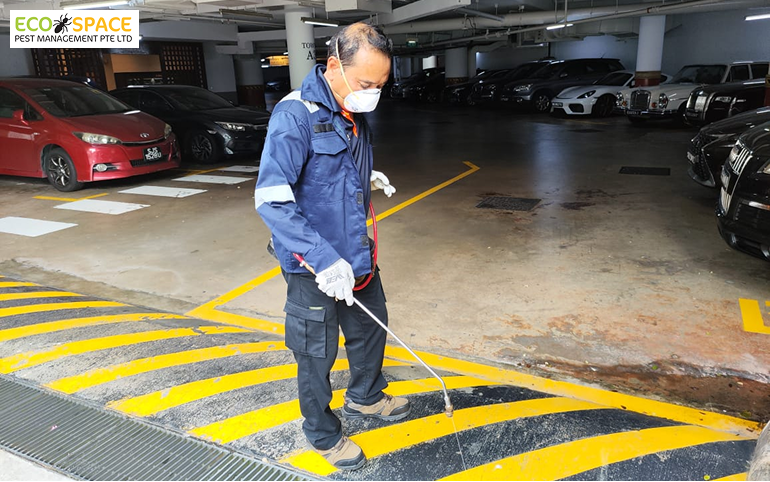
Professional mosquito control involves a site inspection to find breeding sources and resting areas, followed by a combination of source removal, larviciding, and fogging or misting matched to the property. EcoSpace checks drains, roof gutters, floor traps, flower pot plates, discarded containers and shaded outdoor spaces, then applies the most suitable methods:
- Search and destroy: identifying and removing breeding grounds, the step that breaks the life cycle.
- Larviciding: treating water that cannot be cleared so larvae never mature.
- Thermal fogging: fast reduction of adult mosquitoes across gardens, car parks and communal grounds.
- Outdoor and indoor ULV misting: water-based treatment for gardens and patios, and for enclosed or occupied spaces needing low residue.
EcoSpace follows a structured five-step process of inspection, source identification, larviciding, fogging, and preventive recommendations, and the approach is deliberately eco-conscious. For homes, this sits within its residential pest control services across HDB flats, condominiums and landed properties. For businesses, mosquito treatment forms part of commercial pest control in Singapore for offices, warehouses and construction sites, and dedicated restaurant pest control for F&B premises. As an established pest control company in Singapore and a registered NEA Vector Control Operator, EcoSpace can also provide ongoing pest control for mosquitoes rather than a single visit.
What Does Professional Mosquito Control Involve?
A targeted, eco-conscious approach to break the mosquito life cycle and protect your property.
1. Search & Destroy
- Spotting and removing stagnant water sources.
- Goal: Stops the life cycle right at the root.
2. Larviciding
- Applying targeted treatments to water that cannot be drained.
- Goal: Prevents larvae (“wrigglers”) from ever maturing into biting adults.
3. Thermal Fogging
- Rapid knock-down treatment applied across large outdoor areas.
- Best For: Gardens, car parks, and communal grounds.
4. Outdoor & Indoor ULV Misting
- Water-based precision misting for sensitive or outdoor areas.
- Best For: Patios, gardens, and enclosed or occupied spaces needing low residue.
How Do You Prevent Mosquitoes Long Term?
Preventing mosquitoes long term is about denying them water and keeping adults out, done as a weekly habit rather than a one-off. Build these into a routine:
- Remove standing water every week from pot plates, vases, pails, gutters, drains and any container that collects rain.
- Replace water-collecting ornamental plants with those that do not hold water, and loosen hardened soil so pots drain.
- Keep gutters and drains flowing so water does not pool.
- Maintain the garden. Trim shrubs and grass, rake leaf litter, and keep water features clean and moving.
- Fit and maintain screens on windows and doors, and use repellent at dawn and dusk.
- Stay alert near dengue clusters. If your area is flagged, step up water checks and consider professional fogging and larviciding.
How Does Singapore Control Mosquitoes Nationally?
Singapore controls mosquitoes nationally through the NEA’s Mozzie Wipeout campaign and Project Wolbachia, alongside enforcement against breeding. The Mozzie Wipeout asks every household to do a short weekly routine, changing water in vases, turning over pails, removing water from flower pot plates, loosening hardened soil, and clearing roof gutters, because removing breeding water is the single most effective action.
Project Wolbachia is the NEA’s high-tech tool. The agency breeds and releases male Aedes aegypti mosquitoes carrying the Wolbachia bacterium, and when these mate with urban females, the resulting eggs do not hatch, gradually suppressing the Aedes aegypti population that spreads dengue. It launched in Singapore in 2016 and has been expanded to cover a large share of HDB towns. Officials have been clear it is not a silver bullet, which is why source reduction, larviciding and professional treatment remain your first line of defence, particularly for properties outside residential release zones and for commercial and construction sites. You can check whether your address is in an active cluster on the NEA’s dengue clusters page.
Conclusion
Mosquitoes are a year-round, health-relevant pest in Singapore, and the reason they are hard to beat is speed: a missed container of water can become a swarm within a week. The methods that work hit every stage, removing and treating breeding water, keeping adults out, and using professional fogging or misting when activity is high. Fogging clears the adults, but source reduction and larviciding are what keep them from coming back.
If mosquitoes are biting despite your efforts, or your area is in a dengue cluster, a proper inspection is the quickest route to relief. Contact EcoSpace Pest Management for an eco-conscious mosquito inspection and a treatment plan built around your property.
Frequently Asked Questions
How do you permanently get rid of mosquitoes?
There is no permanent, one-off fix in a tropical climate like Singapore’s, because mosquitoes breed continuously wherever water collects. The closest thing to a permanent solution is ongoing control: removing and treating standing water every week, keeping adults out with screens and repellent, and scheduling professional treatment where activity is high. Consistency, not a single treatment, is what keeps a home mosquito-free.
Does mosquito fogging kill larvae?
No. Fogging kills adult mosquitoes present at the time of treatment but does not kill eggs or larvae in water. This is why fogging alone does not end an infestation and must be paired with larviciding and the removal of standing water to break the breeding cycle.
What is the difference between thermal fogging and ULV misting?
Thermal fogging uses heat to create a dense, oil-based fog for fast knockdown of adults outdoors, with little lasting residual. ULV misting uses a water-based spray that dries on surfaces and keeps killing landing mosquitoes for up to about two weeks outdoors and a month indoors, and it is quieter, odourless and better suited to indoor and occupied spaces.
How often should mosquito fogging be done?
Most homes do well with monthly treatment, stepping up during peak dengue months or near an active dengue cluster. Commercial premises and construction sites often need fortnightly programmes to meet NEA compliance standards.
Is mosquito fogging safe for children and pets?
Yes, when carried out by professionals using NEA-approved insecticides and correct procedures. Indoor spaces use water-based misting that leaves no oily residue, and during outdoor thermal fogging you should stay indoors with windows closed and ventilate once the fog has settled.
What is the fastest way to get rid of mosquitoes?
The fastest lasting result combines same-day removal and larvicide treatment of all breeding water with fogging or misting to clear the adults present. Clearing adults without treating the water only buys a few days, because a new generation can emerge within about a week.
Do only female mosquitoes bite?
Yes. Only female mosquitoes bite, because they need a blood meal to develop their eggs, while males feed on plant nectar. Control therefore focuses on suppressing the biting females and removing the water where they lay eggs.
Do plants or candles like citronella keep mosquitoes away?
Only weakly and briefly. Citronella candles and plants can slightly reduce mosquitoes in a very small area for a short time, but they do nothing about breeding water and are not a substitute for source removal, larviciding or professional treatment.
Can mosquito control prevent dengue?
Professional mosquito control reduces the Aedes population that transmits dengue, which lowers the risk of transmission in treated areas. No treatment can guarantee zero risk, but combining larviciding to destroy breeding sites with fogging or misting to clear adults significantly reduces bites and infection risk, especially during Singapore’s warmer months when activity peaks.
 EcoSpace Pest Management Pte Ltd